


Factory Farming is Fake News: What the Headlines Don't Tell You.

Let's talk about the media's favorite f-word.... Factory Farming.
From guilt-tripping fast-food ads to activist campaigns drenched in shock value, the term gets slapped on anything that dares to involve a barn and a burger. It’s the go-to buzzword—crafted to stir emotions, trigger shame, and make you question every bite of bacon. And guess what? It’s working...
Anti-ag activists love to paint a grim picture: livestock are “suffering,” pumped full of mystery drugs, and apparently we’re single-handedly destroying the planet just by raising food.
Here’s the twist — today’s consumers do care more than ever about animal welfare, sustainability, and food safety. But what they often don’t know is that modern agriculture is working around the clock to meet those exact concerns. Ethical practices, sustainability standards, and science-backed production aren’t just buzzwords — they’re the backbone of feeding a growing world. Let's talk about how factory farming is fake news and some of the common misconceptions associated with the term.
Farms are owned by large entities designed for profit and production.
Y’all… this one always gets me.

A quick look at the latest USDA data is enough to squash this myth entirely.
According to the USDA Economic Research Service (2025), 96% of U.S. farms are still family-owned and operated. Among those, 86% are considered small family farms, meaning they gross less than $350,000 annually. And when you factor in the cost of feed, fuel, labor, equipment, and inputs? Most of these families aren’t exactly rolling in cash — in fact, many bring home less than $48,000 a year.
The remaining farms are divided into 6% mid-size and 4% large-scale family operations. That leaves just 4% of all farms in the U.S. that are not owned by the operator. Hardly the corporate monopoly that headlines would have you believe.
But maybe you’ve heard this one too: “Well, yeah Jenna, but that 4% is responsible for feeding the whole country.”
Wrong again.
Naturally, larger operations — whether family-owned or not — produce more food because they manage more land, more animals, and have more infrastructure. That doesn’t automatically mean they’re evil, or that they’re pushing the little guy out of business. It just means they’re built to produce food at scale. And in a country where over 330 million people expect fully stocked grocery shelves year-round, we need that kind of output.
So let’s break down what U.S. food production actually looks like:
48% of the total production value in American agriculture comes from large-scale family farms. Yes — family farms. Not corporations, not mega-conglomerates. Families.
35% comes from small and mid-size family farms, many of which specialize in niche markets, regional production, or direct-to-consumer models.
And only 17% of our total food production value is from non-family operations — the very category most people picture when they hear “factory farm."
That last slice — the 17% — is worth pausing on. It includes things like investor-owned farms, vertically integrated companies, and yes, some large corporations.
Now, let’s talk about vertical integration.
This model is used by many of the remaining non-family operations. Think companies like JBS or Tyson Foods. These businesses own and operate their entire production chain — from the barns where livestock are raised to the processing plants, packaging lines, and even the transportation network that gets products into your local grocery store.

This isn’t some dystopian meat empire — it’s a highly efficient system. Vertical integration allows for better oversight, improved animal care consistency, and reduced environmental impact due to centralized operations. It’s not inherently evil — it’s just different from the traditional family farm model.
And here’s the part no one talks about: many of these companies actually contract with family farmers to raise their animals. That means the chickens you see in a Tyson label at the store may have been raised by a fourth-generation family on their own land, following animal welfare protocols set by the company and monitored for compliance.
Companies like Tyson and JBS don’t profit from neglect — they rely on healthy, well-cared-for animals just like independent farmers do. In fact, their reputation, supply chain, and food safety all hinge on ensuring that livestock are raised humanely and responsibly. The animals in these systems are cared for under strict welfare guidelines — often with veterinarians, nutritionists, and auditors involved every step of the way.
So while the name on the package might be corporate, the care behind the product often still comes from a family farm — and the standards are just as high, if not higher.
The takeaway? Most of the food on your plate comes from families — just families who, in many cases, have scaled up to meet demand, stay competitive, and make a living in a global economy. Big doesn’t mean bad. It means efficient, resilient, and necessary. Understanding that difference changes the entire conversation.
Animals are mass produced in horrible living conditions. It is cruelty!
Okay, let’s take a breath.
Before I hit you with facts, studies, and regulatory breakdowns, let’s just apply some good old-fashioned logic.
If an animal is neglected — if it’s sick, stressed, underfed, or living in unsanitary conditions — what happens? It doesn’t grow. It loses weight. It’s more susceptible to disease. It becomes unproductive.
And here’s the key point: that’s not good for business.
Why would any farmer or operation, large or small, purposely create conditions that harm their animals and ultimately their own bottom line? They wouldn’t. Healthy animals are the foundation of any successful livestock operation — whether you’re raising 50 head or 50,000.
Animal care isn’t just an ethical issue (though it absolutely is); it’s also an economic necessity. If animals aren’t thriving, no one’s profiting. That’s why there are entire protocols, audits, and welfare programs in place — to ensure animals are healthy, comfortable, and performing well.
Cruelty doesn’t just hurt animals. It hurts productivity, efficiency, and the people working to feed the world.
So let's unpack how our food animals in the United States are actually raised (and who's watching).
Most cattle in the U.S. start their lives on cow-calf operations, often on open pasture, where they stay with their mothers for the first 6–8 months. After weaning, they’re moved to backgrounding or stocker operations — think of it like “high school” for calves — where they continue grazing and gaining weight. The final stop? Feedlots, where cattle are provided a balanced ration (typically a mix of hay, corn, distillers grains, and supplements) to finish growing efficiently and with quality marbling. While the word “feedlot” triggers a reaction for some, these are highly managed environments built to prioritize nutrition, safety, and health monitoring.
The U.S. pork industry often takes heat, especially around gestation crates and confinement. Here’s the full picture: pigs are raised in climate-controlled barns that protect them from disease, weather extremes, and predators. They’re given consistent food, clean water, and medical care — often more regularly than we treat ourselves. Sows (mother pigs) may be housed in gestation stalls during pregnancy—not as a form of cruelty, but as a way to provide individualized care and protection during a critical stage of reproduction. These stalls allow farmers to monitor each sow’s health, feed intake, and behavior more closely, ensuring she receives the right nutrition and veterinary care without competition from more
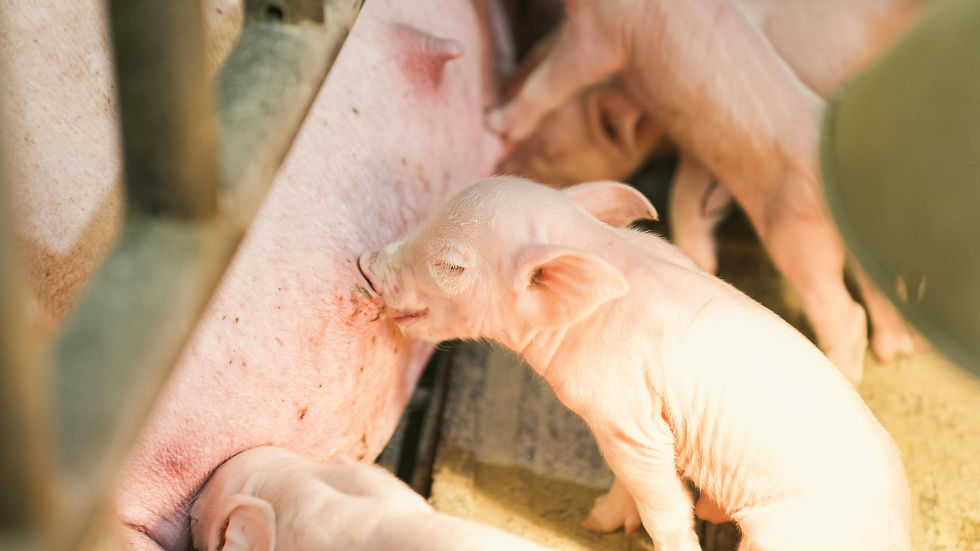
aggressive pen mates. Contrary to what some media portray, pigs are highly social but also territorial, and group housing—especially during pregnancy—can lead to stress, injury, and fighting over food or space if not managed properly. Gestation stalls help reduce those risks. That said, many farms have adopted group housing systems that allow for more social interaction, with new barn designs that prioritize animal comfort and safety. Whether it’s a stall or group pen, the goal remains the same: protect the health and welfare of both the sow and her future piglets, using systems that are science-backed and constantly evolving with new research and welfare audits.
Let’s clear this one up loud and clear: Hormones have been banned in poultry since the 1950s — so if your chicken says “no added hormones,” congrats, it’s just marketing.
Broiler chickens (raised for meat) live in barns, not cages, with open floor plans, access to food and water 24/7, and regulated lighting and ventilation systems to keep them healthy. Most chickens never see a cage in their life. And welfare? It’s a huge focus — because healthy chickens grow better. Farmers monitor feed intake, water usage, and flock health daily. And no, they’re not raised in the dark.
So who’s actually making sure this stuff is legit? Am I just feeding you feel-good talking points, or are there real systems in place to hold farmers and ranchers accountable for how they raise animals? The truth is, animal agriculture in the U.S. is closely monitored by a combination of federal agencies and industry-led programs that set strict standards for
animal care, handling, and welfare.

Multiple organizations oversee and influence animal welfare in U.S. livestock production, each playing a critical role in ensuring animals are raised responsibly. The USDA, through the Food Safety and Inspection Service (FSIS) and APHIS, enforces federal laws around humane handling, transport, and slaughter. Meanwhile, industry-led programs like Beef Quality Assurance (BQA), Pork Quality Assurance Plus (PQA+), and the National Chicken Council’s (NCC) Animal Welfare Guidelines set science-based standards for daily care, handling, and housing—often going above federal requirements. Groups like the National Pork Board (NPB) and National Cattlemen’s Beef Association (NCBA) help fund research, training, and outreach to ensure best practices reach farms of every size. These organizations not only guide how animals are raised, but also hold producers accountable through certification programs, audits, and ongoing education—making them essential to animal welfare, food safety, and consumer trust.
3. Factory farms are ruining the environment and the sole reason for climate change!
One of the loudest criticisms thrown at “factory farms” is their environmental impact — and to be fair, it’s not coming out of nowhere. Livestock operations do produce waste, use resources, and contribute to emissions. But the narrative that large-scale farms are inherently destroying the planet? That’s an oversimplification that ignores the real science
behind sustainability. In reality, larger farms are often more efficient, meaning they use less land, less water, and produce fewer emissions per pound of meat than smaller, less efficient systems. That’s not a guess — it’s backed by decades of research and constant innovation in feed efficiency, manure management, and renewable energy use. For example, many large farms use anaerobic digesters to turn manure into electricity, or precision feed systems that reduce methane output. The USDA and EPA regulate nutrient management plans, runoff, and emissions — this isn’t some free-for-all.

And let’s be serious for a second… we really think that in a society driven by technology, two-day shipping, fast fashion, and AI servers — that cows are the environmental villain? According to the USDA’s most recent data, agriculture accounts for just 11% of total U.S. greenhouse gas emissions. So no, cow's aren't the culprit. That logic is about as sustainable as throwing out your Keurig because the new one syncs with an app
Are there environmental impacts? Absolutely. But pretending that small = good and big = evil completely misses the point. Sustainability isn’t about scale — it’s about how the system is managed. And in many cases, large farms are leading the way.
Let’s wrap this up.
Factory farming has become a catch-all villain in conversations about food and farming — but that label is often based on emotion, not facts. The reality is that most farms are family-owned, highly regulated, and constantly evolving to improve animal care, environmental responsibility, and food safety. From cattle and pigs to chickens and beyond, today’s food animals are raised under the watchful eye of government agencies, third-party auditors, and industry-led welfare programs — not to mention the farmers themselves, who rely on healthy, well-cared-for animals to make a living.
And let’s not ignore why farms scaled up in the first place. It wasn’t to ruin the planet or maximize cruelty — it was to feed a growing population using fewer resources, less land, and less labor. As fewer people stayed on the farm and more moved into cities, food production had to become more efficient. The result? Modern farms that produce more with less — and still manage to keep food affordable, safe, and available 365 days a year. That’s not something to shame. That’s something to understand.
Agriculture isn’t perfect (no industry is), but the story is a lot more complex — and a lot more hopeful — than the headlines would have you believe.
If we want to change the food system, we need to understand it first. Let’s start there.
About the author:

Jenna is a graduate researcher, ag communicator, and current Ph.D. student who’s passionate about cutting through the noise surrounding food and farming. With years of experience studying consumer behavior and advocating for farmers and ranchers, she’s here to help you rethink what you thought you knew about your food—one myth at a time.


Hi Jenna,
This topic is near to my heart, so if you want to talk more about it, email me at nickdu4@yahoo.com.
I am facing a concerning contradiction while reading your article. What you said in the first section doesn't line up with what I've seen from the consumer side. The vast majority of meat product in the stores are sold under major corporate names.
So, if I'm a farmer, and have to sell to a corporation (with specific requirements for the way I run my farm), I can still "own" my farm, yes... Much in the way an owner-operator in the logistics industry owns his truck. But that person has to follow the scheduling and set of rules placed…